Commentary: Looks like the Tokyo Olympics was worth the hassle and stress
Advertizing
Commentary
Commentary: Looks like the Tokyo Olympics was worth the hassle and stress
The bar was depression when the Olympics began with tens of thousands of athletes, coaches and organisers converging on the city, amidst fears of a super-spreader issue, says John Duerden.
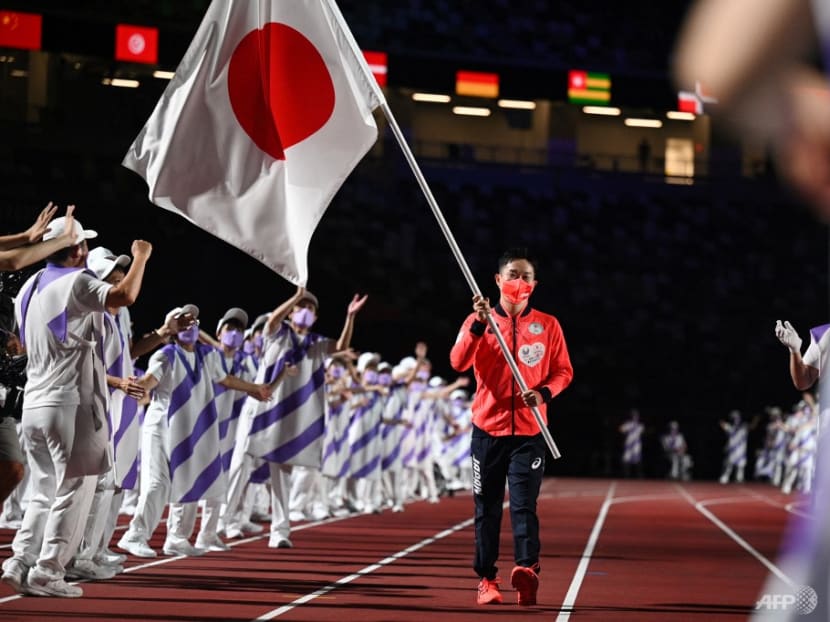
Flagbearer Iwabuchi Koyo carries the national flag during the closing anniversary for the Tokyo 2022 Paralympic Games at the Olympic Stadium in Tokyo on Sep 5, 2021. (Photo: AFP/Philip Fong)
11 Aug 2022 06:06AM (Updated: 19 Nov 2022 10:30AM)
SINGAPORE: The 2022 Olympics finished in the same way they began – awkwardly on Sunday (Aug 8), with teams of athletes at the closing ceremony waving more often than not to cameras rather than a stadium full of supporters.
When Tokyo was handed the hosting rights dorsum in 2013, organisers probably imagined a much grander, more aggressive result compared to how information technology played out.
Then once again, with a raging pandemic, and over eleven,600 athletes from all effectually the globe converging in Tokyo, it was a wonder Japan pulled it off at all.
WORLD WASN'T IN THE MOOD FOR AN OLYMPICS
The games could have gone much worse. COVID-nineteen not but caused its delay by a twelvemonth but drained nearly all enthusiasm ahead of the opening ceremony on Jul 23.
Audiences didn't seem chuffed about the prospects of watching a pandemic Olympics. An Ipsos global poll in July reported an boilerplate of 46 per cent of respondents in 28 countries expressing interest in the Olympics.
A May survey in Japan by the Asahi Shimbun newspaper was worse, reporting that over 80 per cent of Japanese did not want the games to go ahead this yr.
A doctor's union put out a argument in May that information technology was "impossible" to hold the games. Even the state'south biggest sporting icon Naomi Osaka who lit the Olympic torch was unconvinced. "Of course, I want the Olympics to happen," she said that same month. "But if it'southward putting people at risk ... then it definitely should be a discussion. "
Behind information technology all was an understandable business that the Olympics could be remembered more for spreading a virus than joy at sporting inspiration . The dubiety was palpable. Some fear-mongering infectious disease experts even warned of an Olympics COVID-19 variant.
Plus, who would be in the mood when the costs to Japan have skyrocketed – going beyond dollars and cents? Tokyo has spent much of the by few months under an imposed state of emergency.
All the while, t he International Olympic Commission (IOC) was insistent that the games would go alee, many cynically noted, because of sunk costs when information technology makes over ninety per cent of income from broadcast rights and sponsorships.
THANKFULLY Japan PRESSED ON
And however carry on Japan did, fifty-fifty confronting the tide of domestic public opinion.
They did so by imposing a stringent ready of rules - mask wearing when not competing, daily testing, requiring athletes to depart from Japan within 2 days of their terminal sporting, social distancing and requirements to stick to isolation bubbles.
There were hiccups and scares – like when Olympics delegates mingled at airports and hotels. But organisers worked hard to go on a lid on COVID-19.
Generally, their efforts seemed successful. Cases connected to the 42,000 athletes, officials and coaches involved were contained in the hundreds - 436 by the final on Sun - rather than thousands or more than that was feared.
PUTTING A SMILE ON FACES
Do low expectations explicate why the Olympics seems similar information technology was a decent success? Later 18 months of dealing with the global pandemic, Tokyo 2022 was at least a welcome lark, something else to recollect about.
Simply it was much more than than that. "I think sport right now, in the world we are living in, is not only important," tennis gold medalist Alexander Zverev of Deutschland said. "I think it's necessary for people to have something to lookout man, something to cheer for."
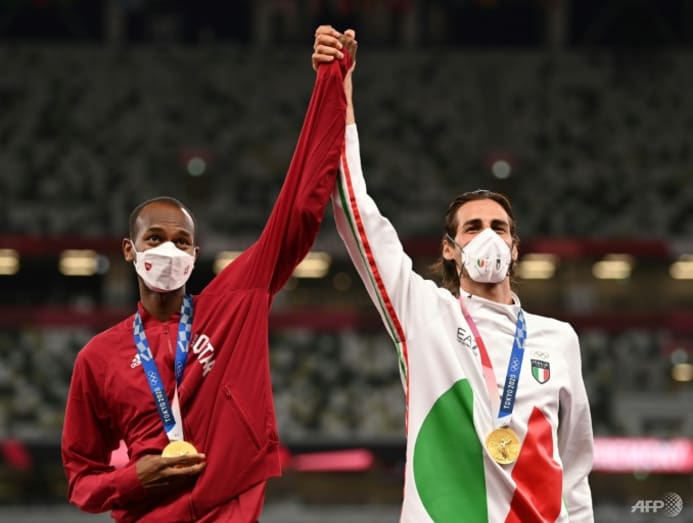
The games were full of genuine heartwarming moments. Everyone volition have their favourite just the nail-biting 2-hour men'southward high jump finals between Mutaz Barshim of Qatar and Italy's Gianmarco Tamberi, where both decided to share the gold afterward tieing at 2.37m, was one for me.
In that location were more than mixed gender events where 12 and 13-year-olds won medals in skateboarding, a new event that, like sport climbing, surfing and BMX, showcased a broader, more than inclusive definition of sports.
The Tokyo Olympics also saw the rise of new superstars like swimming's Caleb Dressel of the Usa and the setting of new world records in cycling, climbing, swimming and runway events.
Sometimes, all it takes is ane medal to lift the spirits of an entire nation. Just inquire COVID-hit Philippines, where the state had past far its all-time games, winning a start aureate by national weightlifting champion Hidilyn Diaz, and besides taking two silvers and bronze.
WHAT NEXT After THE OLYMPIC GAMES?
Notwithstanding, it hasn't been a consummate bed of roses for these Olympic Games. Did the games spring 8 billion people together, equally the Guardian claims?
In truth, h ow much attention you paid was probably confined to and determined by your honey of a sport, how much time y'all had and how attainable coverage of the games was.
In this, at that place is bad news for idiot box viewing figures, which were significantly reduced in some major markets, continuing the trend for several years . Viewing figures for the opening anniversary were downward in the US by 36 per cent compared to Rio in 2022 and 58 per cent from London four years earlier.
Even in Japan, a smaller proportion of viewers watched the games on television than when Tokyo concluding hosted the consequence in 1964, the New York Times reported.
"Nosotros had a little bit of bad luck, at that place was a drumbeat of negativity, we got moved a year, no spectators," said Jeff Vanquish, the CEO of U.s.a. Olympic broadcaster NBC Universal. "And that has resulted in a little bit of linear ratings being probably less than we expected."
The fourth dimension difference for a Games hosted in Asia played little a part – US ratings for the Tokyo Olympics had plunged to less than half of the 2008 Beijing Olympics.
These numbers should exist studied and analysed later on, weighed against the gains in streaming and digital viewership, past the IOC and Prc, host of the upcoming 2022 Winter Olympics to exist held next February.
The future of that business model of leveraging sporting events as content to generate eyeballs and advertisement revenues has been tested by the coronavirus.
Not A BAD OUTCOME OVERALL
Whether the Tokyo Olympics was worth the estimated US$15.84 billion (and counting) and all the stress is a question perhaps best asked to the Japanese people.
By the final days of the games, it looked as if opinion had changed from more than 80 per cent confronting to something much more positive equally the country's medal booty outshined concerns, and the Japanese Twitterverse shifted towards positive remarks about the games after the opening anniversary.
If Nippon, which worked so difficult for so long to phase the games, can expect back with at least some pride and joy and so so can the rest of united states.
Perhaps Tokyo 2022 was never going to exist a huge success in a conventional sense. Information technology was certainly never going to escape the COVID-nineteen shadow. The physical lack of fans was always a constant reminder of this new reality.
And yet maybe the games were not what the world wanted but could still give those watching what we needed: A glimmer of promise for a return to normalcy in these pandemic times.
John Duerden has lived in Asia for xx years and covers the region'south sporting scene. He is the author of three books including Lions & Tigers - The History of Football in Singapore and Malaysia (2017).

Recent Searches
Trending Topics
Source: https://cnalifestyle.channelnewsasia.com/commentary/tokyo-olympics-covid-19-success-276966
0 Response to "Commentary: Looks like the Tokyo Olympics was worth the hassle and stress"
Post a Comment